
The concept of a castle is often shrouded in ambiguity, but for the sake of clarity, we’ll define it as the private, fortified residence of a lord or noble.
The earliest castles in Scotland emerged in the 11th and 12th centuries, influenced by the introduction of Anglo-Norman architecture. Initially, these structures were motte and bailey castles, which were later replaced by stone-built castles around 1200. Before the advent of castles, Scotland’s landscape featured various forms of fortifications, including hill forts, brochs, and duns.
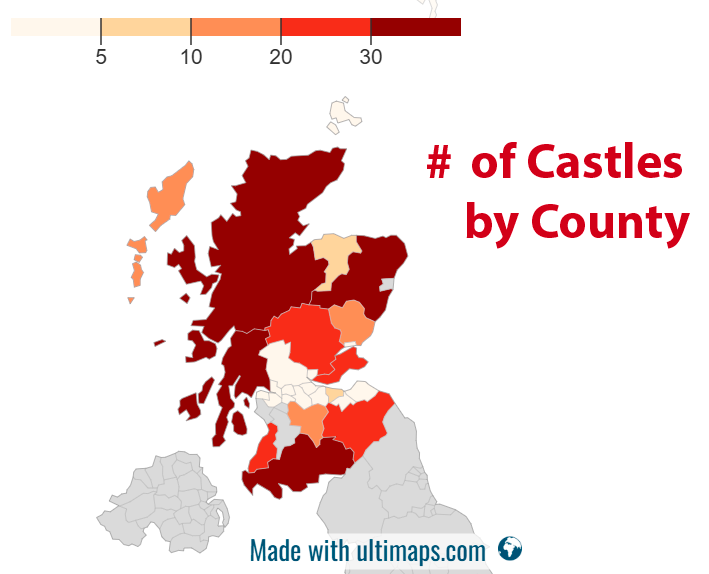
Over the centuries, Scotland has been home to over 2,000 castles, although many are only known through historical records. For our analysis, we’ve selected a representative sample of 300 unique historical structures, based on a 33-county administrative framework.
Our findings revealed certain regions are ‘well endowed’ – Aberdeenshire taking the lead with 36 identified structures, closely followed by Argyllshire (33) and Dumfriesshire (25). In contrast, other counties have a significantly lower number of identified structures, highlighting the diverse historical development and strategic significance of castles across Scotland.