
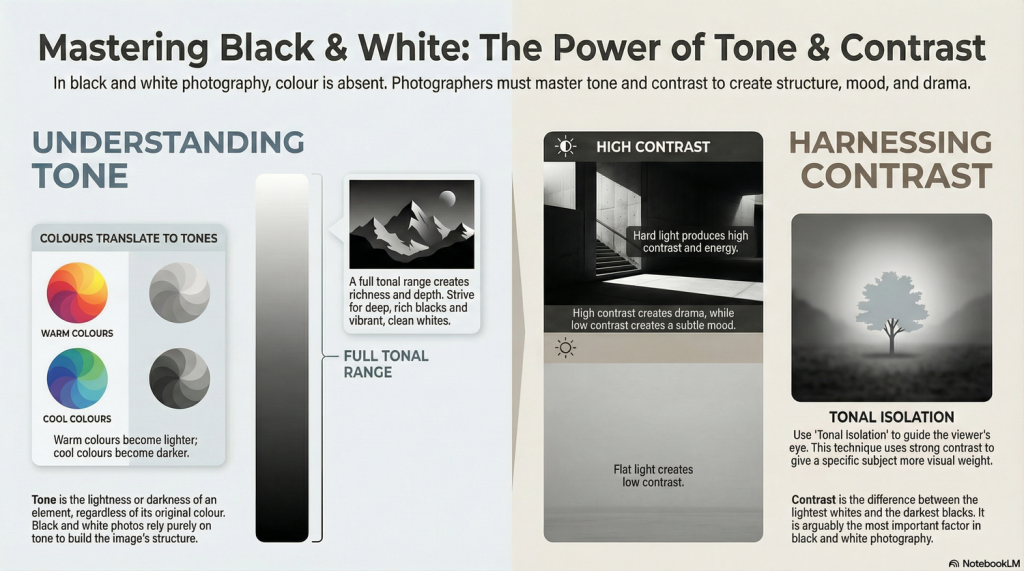
Understanding tone and contrast is fundamental to creating compelling black and white photography, as these elements replace color to provide structure, mood, drama, and visual interest.
The Enhancement Provided by Tone
Tone refers to the lightness or darkness of an element, regardless of its original color. Black and white photographs rely purely on tone.
1. Creating Structure and Guiding Attention:
◦ Understanding tone is essential to building strong compositions.
◦ A skilled photographer uses the right balance of light and dark gray tones to provide structure and guide a viewer’s eye through an image.
◦ Tone can be used to direct the viewer’s attention within black and white portraiture.
2. Achieving Richness and Depth:
◦ Legendary photographers like Ansel Adams were renowned for their dedication to tonal values, which included deep, rich blacks and vibrant, clean whites with a full scale of tone in between. Striving for these deep, rich blacks and creamy, vibrant whites is a goal for quality black and white photography.
◦ Tone is used to create an illusion of form, a sense of depth, and atmosphere.
◦ Thinking about how the colors observed in a scene will appear as tones when rendered in black and white helps in making more interesting compositions. For instance, cooler colors (blues, greens, purples) generally render as darker tones, while warmer colors (reds, oranges, yellows) render as lighter tones.
3. Visualizing the Image:
◦ Learning to “see” in black and white means training your eyes to look beyond color and perceive different shades of contrast.
◦ Tone variance is crucial for managing the appearance of depth. By knowing how to control exposure, a photographer can make any surface the tone they desire, affording greater creative freedoms.
The Enhancement Provided by Contrast
Contrast is defined as the difference between the lightest white and the darkest black in an image. Tonal contrast specifically refers to the difference in tones from black to grey to white. Contrast is arguably the most important factor in black and white photography.
1. Creating Drama and Mood:
◦ Strong contrast, created by distinctive light and shadows, contributes to strong black and white images.
◦ The contrast between the blacks, grays, and whites gives photographs a very strong feel, making a black and white photograph incredibly effective at creating drama and mood.
◦ Hard light, which creates high contrast with deep, defined shadows, can express a more emphatic mood and produce tension. High contrast tends to inject a feeling of energy into a photograph.
2. Emphasis and Style:
◦ Photographers can use contrast to subliminally send a message about the subjects in their photos.
◦ Low contrast, which is inevitable when lighting is flat and even, can be used intentionally to create a mood or to maximize the message displayed in a subject’s body language.
◦ Contrast enhances visual interest, particularly texture. Side lighting often creates heavy shadows, emphasizing surface texture and contributing to low-key images.
3. Tonal Isolation:
◦ A specific powerful technique is tonal isolation, which uses contrast to direct a viewer’s eyes to a particular location within the black and white image.
◦ Tonal isolation is used to add greater visual weight to one subject or area over another. For example, even in a busy scene, the power of tonal separation can draw the eyes right toward a specific subject.
Understanding tone and contrast together is like mastering the entire gray scale, allowing the photographer to treat black and white like a painter treats their palette: manipulating the shadows, highlights, and mid-tones to control where the viewer looks, how they feel, and what story the image tells, all without the aid of color.