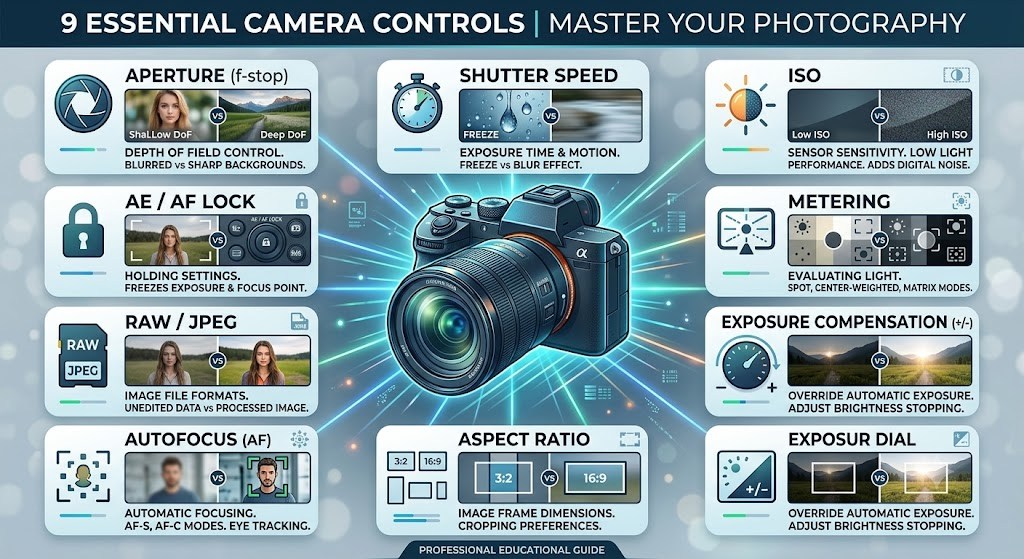
Very often, new photographers feel deeply disappointed when their initial images fail to match their creative expectations. Rather than buy more and ‘better’ gear we encourage you to thoroughly understand your existing camera’s specific capabilities by actively studying the manual (RTFM) and master these fundamental dials.
The following table, outlines nine critical settings found on nearly all modern digital cameras, that we believe are essential to master. They begin the foundational “big three” variables: aperture, shutter speed, and ISO. Then delve deeper into more advanced functional features such as metering, auto-focus modes, image quality options, and exposure compensation all of which contribute to creating the optimal image.
9 Essential Camera Controls
Control
Description
1. Aperture
This setting dictates the amount of light passing through the lens and is measured in f/stops. It controls exposure and depth of field; wider openings allow for faster shutter speeds and pleasing background blur.
2. Shutter Speed
Shutter speed determines the exact amount of time the shutter stays open to expose the digital sensor. Fast speeds perfectly freeze fast motion, while slower speeds intentionally blur movement for long -exposure photography.
3. ISO
ISO controls the digital sensor’s chemical-equivalent sensitivity to light. While higher values help you shoot in darker settings without blurry results, they unfortunately introduce unwanted digital noise into the image.
4. Photometry (Metering Modes)
This refers to how your camera utilizes its internal light meter to determine the scene’s optimal exposure. Options usually include spot metering for specific subjects and matrix averaging to balance contrasting lighting conditions.
5. Exposure Compensation
This practical tool allows you to override the camera’s automatic exposure estimates. If an image appears too dark or light, you can easily dial in positive or negative compensation to manually fix the brightness.
6. Aspect Ratio
Aspect ratio describes the proportional difference between your image’s length and width. Experimenting with different framing ratios, from completely square to cinematic widescreen, can effectively provide your artistic creativity with a massive boost.
7. Autofocus Settings
Cameras offer various focus modes, including single focus for stationary subjects, continuous focus for moving action, and manual focus. Properly setting the size and position of your focus points guarantees sharp, accurate results.
8. Quality (RAW and .JPEG)
This determines the digital file format your camera saves. Shooting in RAW provides maximum data flexibility for extensive post-processing, whereas .JPEG offers a faster, highly convenient format that requires significantly less editing.
9. AE/AF Lock
These convenient buttons allow you to instantly freeze your auto exposure (AE) or autofocus (AF) settings at a specific moment. This keeps your exact metering and focus securely locked while you reposition the frame.
Fully familiarizing yourselves with these vital tool will help you stop fumbling with the camera, catch the odd shot you wouldn’t have previously and confidently start focusing on honing your artistic vision and composition skills and as a by product minimize post-processing time.