
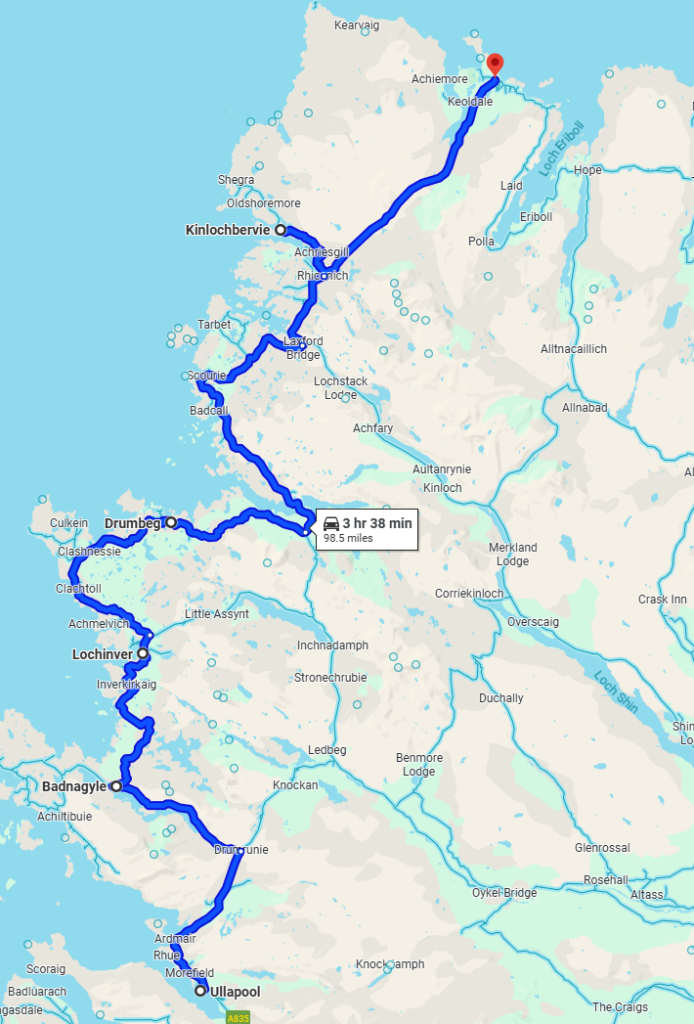
Ullapool to Durness is almost 100 miles and because much of it is on single track road the journey can easily take 4 to 4.5 hours without stopping for photographs – AND YOU WILL – the road winds past Assynt’s sculpted peaks—Stac Pollaidh, Suilven, and Quinag—framed by shimmering lochs.
Light changes fast here, creating dramatic contrasts and fleeting golden-hour moments. White-sand beaches like Achmelvich and Clashnessie glow against turquoise waters, while moody skies add texture to rugged cliffs. Every bend reveals a new perspective, from mirror-like reflections to vast seascapes. For the patient photographer, this route delivers raw Highland beauty in every frame.
Ullapool to Badnagyle spans about 15 miles. Start by heading north on the A835, enjoying views of Loch Broom, then turn west onto an unnumbered road signposted for Achiltibuie (Archiltibuie). This single-track lane winds through the Inverpolly Nature Reserve with its’ dramatic landscapes of ancient mountains like Cul Beag, Stac Pollaidh, Cul Mor, Suilven, and Quinag—remnants of a vast eroded range. The drive takes around 30-40 minutes, offering an austere wilderness feel with lochs, rocks, and sparse vegetation. Wildlife sightings are common, from red deer to golden eagles. The road is narrow with passing places, so driving is slow and deliberate, but the scenery rewards every mile. Approaching Badnagyle, the landscape opens to sweeping views over Loch Lurgainn, with its mirrored waters reflecting the surrounding hills, marking a junction on the “Wee Mad Road” to Lochinver.
Badnagyle to Drumbeg via Lochinver is about 26 miles. The journey from Badnagyle to Drumbeg is a very slow, winding drive blending the “Wee Mad Road” and Drumbeg Loop. You’ll travel through some of the most striking landscapes in the northwest Highlands. The single-track road skirts the shores of Loch Lurgainn before climbing into a rugged moorland dotted with lochans and framed by peaks like Suilven and Canisp. This stretch offers constant changes in light, with distant mountains shifting in mood under fast-moving clouds. Small bays and inlets appear unexpectedly, with turquoise waters contrasting against dark rock. Approaching Drumbeg, the road twists through dramatic coastal scenery, revealing panoramic views over Eddrachillis Bay and its scattered islands. It’s a route where every mile feels wild and untouched.
The journey from Drumbeg to Kinlochbervie is around 40 miles Leaving Drumbeg, the narrow road threads along the shoreline, offering sweeping views over Eddrachillis Bay’s sparkling waters and scattered islands and continues on through a captivating mix of rugged coastal vistas and the remote moorlands of the Assynt landscape with lochs and rugged mountains like Quinag. Continuing north to Kylesku Bridge, an iconic curved structure offering panoramic views over Loch a’ Chàirn Bhàin. The route passes small crofting communities, rocky headlands, and hidden coves, with constant changes in light creating endless photographic opportunities. The beach at Scourie is a great stopping place and a small diversion to Tarbet to visit Handa Island is well worth it. Inland, the road winds through peat moors and freshwater lochans, framed by distant mountain silhouettes. As you approach Kinlochbervie (not actually on the NC 500, but a good place for a pit stop), the scenery softens, opening to views of fishing boats, sheltered harbours, and the promise of nearby beaches like Oldshoremore. It’s a journey rich in contrasts and atmosphere.
From Kinlochbervie to Durness is a short (19 miles) but unforgettable stretch of the NC500, with breathtaking views of rugged coastlines, shimmering lochs, wild moorlands, and dramatic Highland landscapes – dramatic though with a sense of remote tranquillity. Leaving Kinlochbervie, the road winds past quiet lochs and rugged hills before opening to breathtaking views over Balnakeil Bays’ sweeping sands. A detour to Oldshoremore or Sandwood Bay rewards with some of Scotland’s most pristine beaches, framed by turquoise waters and towering dunes. The route hugs wild moorland, where changing weather paints the landscape in shifting light and shadow. As you near Durness, the Atlantic’s power becomes more evident, with cliffs, sea stacks, and caves hinting at the area’s raw, untamed beauty.