
Summary
For many new photographers, the transition from “taking snapshots” to “pursuing photography” is often accompanied by the advice to shoot exclusively in RAW. The following report argues that beginners / novice photographers should prioritize high-quality JPEG files over the technically demanding RAW format and complex post-processing.
Choosing high-quality JPEGs is a strategic decision that prioritizes creative growth. According to Adobe (Photoshop creator) and Digital Photography School, JPEGs arrive “finished,” with the camera automatically handling sharpening and saturation. This allows novices to master fundamentals like composition and exposure without getting bogged down in software.
Modern algorithms have made JPEGs more powerful than ever (Alex Smale), offering universal compatibility and efficient storage (Format Magazine).
For those starting with smartphones or point-and-shoots, high-quality JPEG is not just a convenience – it is a pathway to immediate enjoyment and faster learning.
1. Instant Shareability
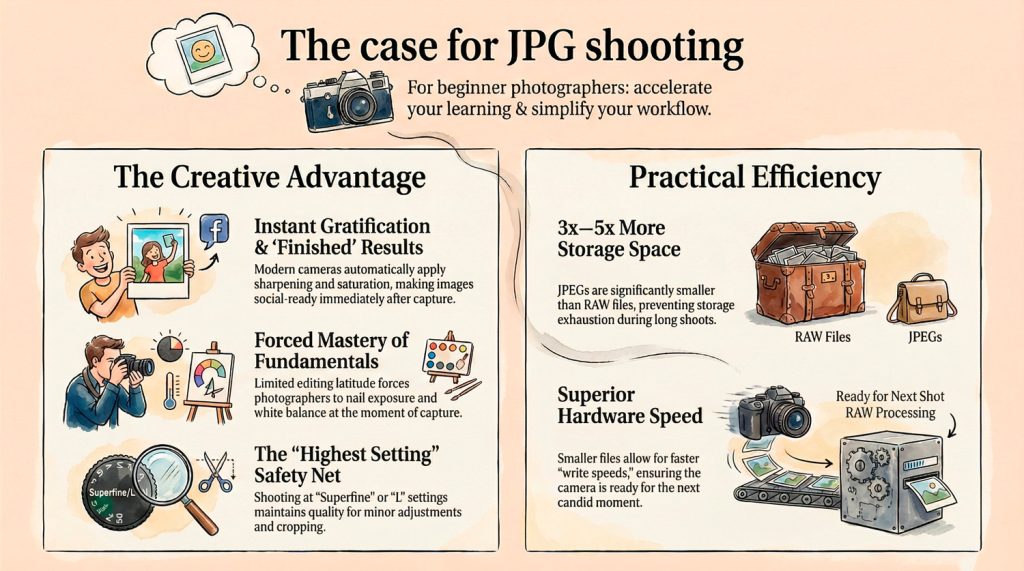
The primary advantage of JPEG is that the image is “finished” the moment you press the shutter. That said, for those beginning their journey in photo-editing, the option to ‘tweak’ an image is still open.
- In-Camera Processing: Unlike RAW files, which appear flat, dull, and desaturated, JPEGs benefit from the camera’s internal engine. This engine applies sharpening, contrast, and color saturation based on years of manufacturer research (Adobe, 2025).
- Social Ready: For mobile and casual users, the goal is often sharing. JPEGs are universally compatible and ready for social media or messaging instantly, whereas RAW files require specialized software (Lightroom, Capture One) to even be viewable (ON1, 2025).
2. Focus on “The Moment” Rather Than the Screen
New photographers often fall into the trap of thinking they can “fix it in post.” By shooting JPEG, a beginner is forced to pay more attention to the fundamentals, IF they really want to create ‘click worthy’ images :
- Exposure and Composition: Because JPEGs have less “latitude” for extreme lighting corrections, you SHOULD learn to nail your exposure and white balance at the time of capture (Thom Hogan).
- Intentionality: Knowing you cannot easily change the color temperature or pull detail out of a blown-out sky later SHOULD make you a more disciplined observer (Digital Photography School, 2025).
3. Practical Resource Management
Technical constraints are a reality for point-and-shoot and smartphone users.
- Storage Efficiency: A typical RAW file can be 3 to 5 times larger than a high-quality JPEG. For a novice on a long trip with a single SD card or limited phone storage, shooting RAW can lead to running out of space at a critical moment (Format Magazine).
- Hardware Speed: Smaller JPEG files allow for faster shooting and quicker “write speeds”, so the camera is ready for the next shot sooner, VITAL for candid moments or fast-moving subjects.
4. The “Highest Setting” Caveat
The recommendation is specifically to use JPEG at its highest setting (often labeled “Fine,” “Superfine,” or “L”). This provides a “safety net” of quality that still allows for minor crops or basic brightness adjustments without the file falling apart (Stack Exchange).
Conclusions
Ultimately, photography is about the thrill of the capture and the art of seeing.
Don’t let the technical complexity of RAW files act as a barrier to your creativity. Prioritising simplicity and immediacy helps new artists remain engaged with the joy of photography as well as a chance to focus on taking ‘better’ photos while trusting your camera’s modern technology to handle the processing.
Doing so, allows you to stay present in the moment and find immediate joy in the images you create rather than becoming overwhelmed by post-processing requirements.
By shooting JPEG, you ensure your images are instantly shareable and your workflow remains simple.
Sources
Primary Sources & Further Reading
- Adobe: Shoot RAW vs. JPEG: Which format should you choose?
- Covers the “finished” look of JPEGs and why speed and storage matter for casual or entry-level use.
- Digital Photography School: RAW vs JPEG: Which File Type Is Best?
- Detailing how JPEGs handle processing like sharpening and saturation automatically, saving beginners from complex editing.
- Alan Ranger Photography: JPEG vs RAW: The Key Differences – A Guide for Beginners
- Offers a practical breakdown of when the universal compatibility of JPEG outweighs the benefits of RAW.
- Format Magazine: Shooting RAW Vs. JPEG: Which Format Is Right For You?
- Focuses on the resource management aspect, including storage efficiency and ease of sharing.
- Thom Hogan (byThom): You Want Great JPEGs? Here’s the 411
- An expert deep-dive into mastering the JPEG format to improve fundamental photography skills like exposure and white balance.
- Alex Smale: RAW vs JPEG vs HEIF in 2026: Which Should You Shoot?
- A contemporary look at how modern camera algorithms have made JPEGs even more capable for current users.