
Headline takeaway:
Cinematic color isn’t “magic” or taste alone—it’s math. ChromeLUT+ shows that the movie look can be replicated by statistically matching color distributions, making high-end grading accessible to anyone. It’s available on our FREE AI Resources page.
Summary
- The core problem:
Replicating a cinematic look often fails because most presets are static. They apply fixed adjustments that ignore the unique lighting, contrast, and color distribution of each image, leading to muddy or artificial results. The issue isn’t skill—it’s access to proper color science. - The key shift: color as data, not decoration
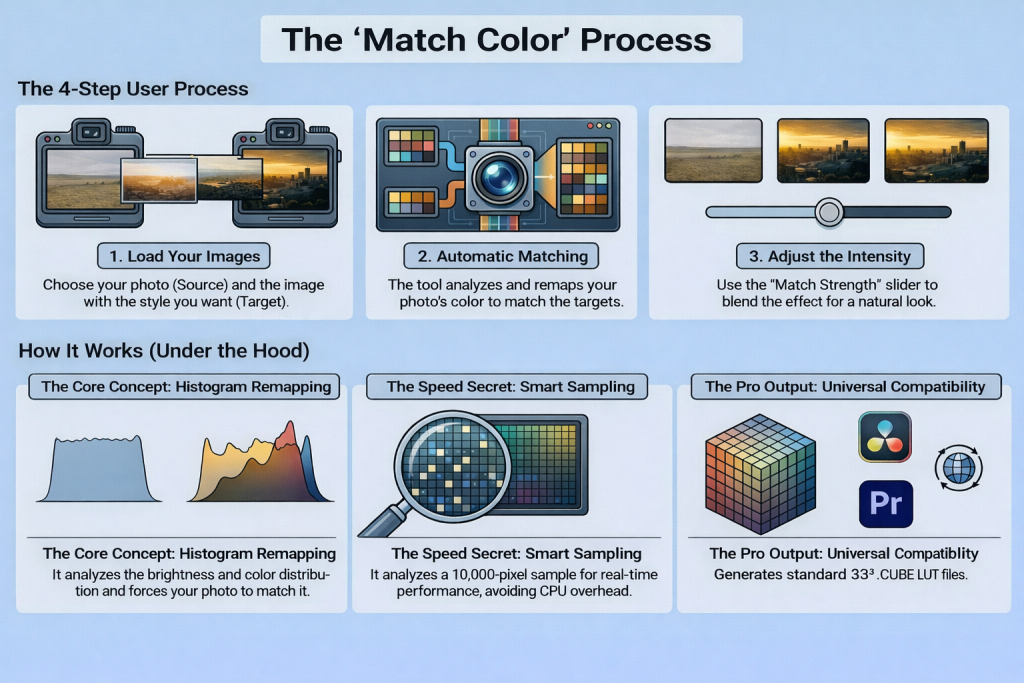
ChromeLUT+ replaces generic filters with histogram remapping. Instead of applying a look on top of an image, it analyzes a reference (“Target”) image and forces the source image to adopt the same statistical color footprint—its brightness and color distribution. This makes the result feel integrated and natural rather than painted on. - Performance through smart sampling
To avoid heavy processing, the tool downsamples images to a 100×100 proxy, generating 10,000 data points per image. This is enough to accurately model color distributions while keeping CPU/GPU demands low. The result: smooth, real-time performance even on modest hardware like Chromebooks. - Under the hood: serious math
The engine uses Cumulative Distribution Function (CDF) matching, calculating probability distributions independently for the Red, Green, and Blue channels. It then builds lookup tables to align the source image with the target. Crucially, this runs through an SVG feComponentTransfer pipeline, offloading computation to the GPU and keeping the interface responsive. - Math needs taste
Pure statistical accuracy can be too aggressive. A Match Strength control lets users dial back the effect—around 70% often produces a more natural, cinematic blend. A built-in comparison slider helps check for crushed blacks or blown highlights, protecting image integrity. - From browser toy to pro workflow
Once a look is finalized, ChromeLUT+ can export it as a 33×33×33 .CUBE LUT—the industry standard. That means a look developed in a web browser can be dropped straight into professional tools such as Resolve.
Tools like this are democratizing cinematic color and cause the focus to shift from technical grading to creative curation and storytelling choices.