
Julieanne Kost of Adobe outlines a structured framework she has developed for crafting precise AI prompts to improve image editing and animation.
The methodology emphasizes a three-part system that combines overall creative direction with specific visual details and explicit restrictions to ensure predictable results. It highlights the value of iterative refinement, suggesting that users should prioritise essential instructions and use AI assistants to translate visual concepts into technical language.
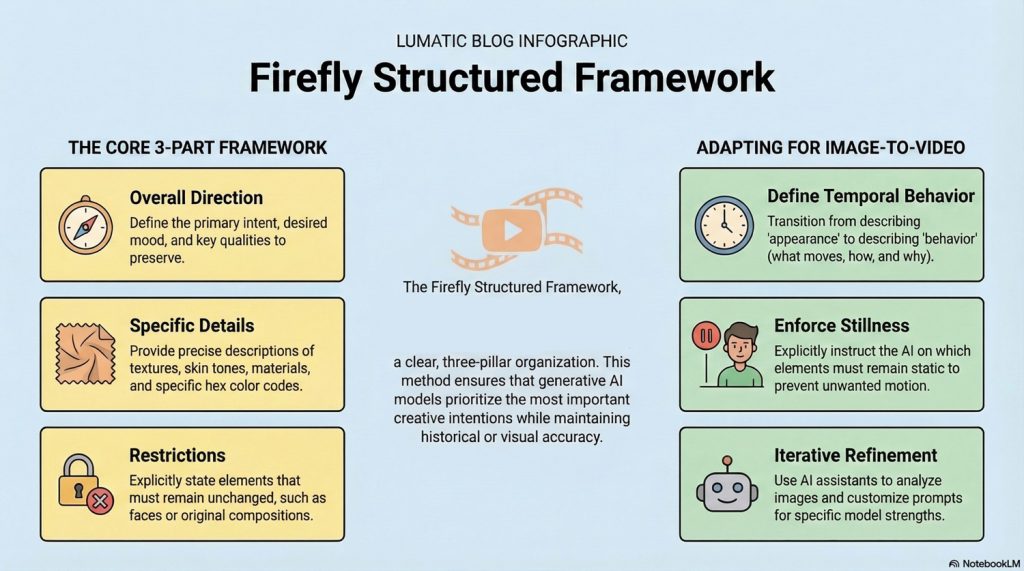
For video projects, the guide explains how to shift from describing static appearances to defining behaviours and movement over time. Ultimately, the source serves as a practical manual for maintaining creative control while leveraging the strengths of different generative models.
A more detailed but simple to follow set of slides may be downloaded here.
If you wish to maintain historical accuracy, you must explicitly specify details like lighting in your prompt and during the refinement process to achieve better realism and authenticity. If you are extending your edits to video or animation, you should also include boundaries in your prompt that instruct the AI to keep the lighting static and consistent.
However, Julieanne’s workflow does not provide examples of the exact vocabulary or the “best way” to describe historical lighting itself. Applying the general prompting framework from the sources, the best approach would be to avoid ambiguous wording and instead use precise visual details when setting your overall direction.
Note: Because the provided sources do not list specific descriptive terms for historical lighting (such as “harsh early flashbulb” or “soft gaslight”), you may need to independently research the exact lighting terminology and characteristics of the specific historical era you are trying to recreate to get the best results.
Of course this framework may be used for creating images using any AI.