
Introduction
Want to add dynamic motion to a static photo? Today’s newest filters achieve this with a principle first mathematically defined in foundational computer graphics research from Bell Laboratories over four decades ago.
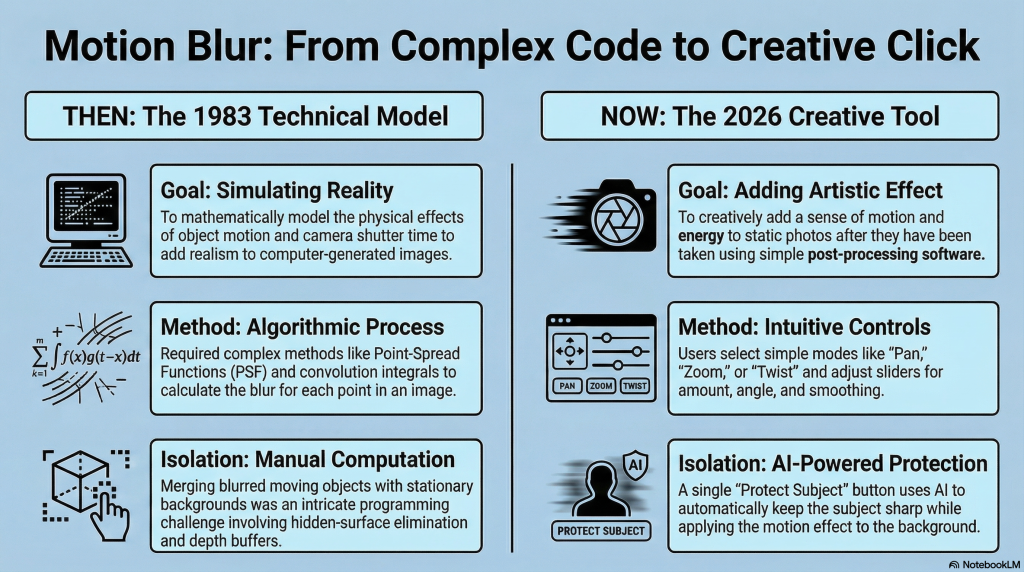
1. That “New” Motion Filter is Built on 40-Year-Old Science
1.1. The Modern Tool ON1 Photo RAW 2026’s new Motion Filter simulates camera movements like panning, zooming, and twisting after the shot.
1.2. The Scientific Foundation The scientific principles were detailed in the 1983 paper, “Modeling Motion Blur in Computer-Generated Images,” by researchers at Bell Laboratories.
1.3. Analysis This represents the long, often invisible journey of foundational ideas from the research lab to the artist’s creative suite—a testament to the enduring value of pure research in shaping future technologies.
2. Motion Blur Isn’t Just Smudging—It’s a Mathematical “Function”
2.1. The Core Concept Motion blur is not a random smudge but a precise mathematical model. The 1983 paper described this using the “optical system-transfer function,” a concept now commonly known as the Point-Spread Function (PSF). The PSF precisely describes how an object’s light energy distributes across the image as it moves.
2.2. Analysis This complex convolution mathematics is now completely abstracted from the user, conveniently packaged behind simple software sliders for “Amount” and “Angle.”
3. Faster Motion Creates a Fainter Image
3.1. The Counter-Intuitive Physics One might assume faster motion creates a more intense blur. The 1983 paper reveals the opposite is true.
3.2. A Direct Quote from the Science
“…as the object moves faster its image spreads over a greater image area with reduced intensity.”
3.3. Analysis This is because the object’s finite light energy is spread over more pixels during the exposure, making each point in the resulting blur appear dimmer.
4. From Simulating Reality to Creating Illusion
4.1. The Original Goal The original 1983 goal was to add realism to synthetic, computer-generated images by simulating the optical effects inherent to real-world cameras.
4.2. The Modern Goal Modern tools like the ON1 Motion Filter work in reverse, applying a simulated effect to a real photograph to create an artistic illusion of motion that never occurred.
5. Today’s “Protect Subject” Button Solves an Old, Hard Problem
5.1. The Challenge of Occlusion The 1983 paper noted that modeling motion is complicated by “object occlusions”—a challenge that in photography translates to the difficult task of separating a subject from its background to apply a selective blur.
5.2. The AI-Powered Solution The ON1 Motion Filter’s “Protect” feature uses AI to automatically identify and isolate a subject from the blur effect.
5.3. Analysis A one-click AI feature today elegantly solves a problem that once required bespoke algorithms for time-and-depth buffering, now abstracted behind a single, AI-driven toggle.
Conclusion :
This fusion of seminal research with modern AI suggests a new frontier where other foundational computer science principles await rediscovery, poised to unlock the next generation of creative tools.