
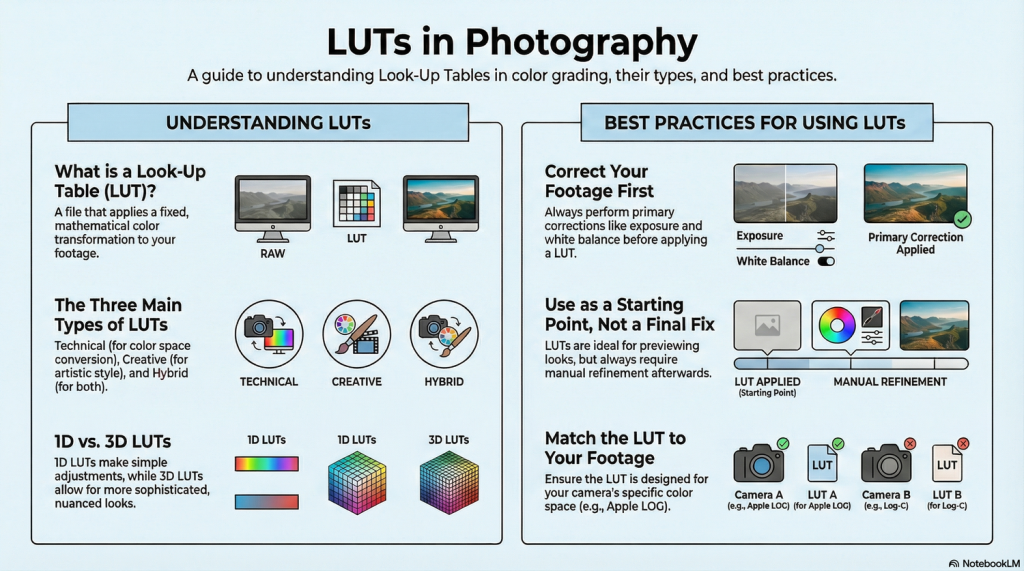
What is a LUT, really?
At its simplest, a LUT (Look-Up Table) is like a translator for color. Imagine you have a specific shade of blue in your camera, but you want it to look like a moody teal from a cinema movie. A LUT is the instruction manual that tells your software: “Whenever you see this Blue, turn it into this Teal.”
While the tech behind it is just a grid of math, for you as a creator, it functions like Instagram filters on steroids. It grabs all the colors, brightness, and contrast in your image and shifts them instantly to match a specific recipe.
Why Photographers Love Them
LUTs generally solve two major problems:
1. The “I need my life back” Factor (Speed) If you have ever shot a wedding or an event, you know the pain of staring at 2,000 photos that all need editing.
- Instead of tweaking every slider for every photo, you apply a LUT.
- It gives the whole batch a consistent, polished “family resemblance” instantly.
2. The “Vibe” Factor (Creativity) Have you ever looked at a photo and thought, “Why does this look so digital and clinical?” LUTs add character.
- Film Emulation: They can make a digital file look like vintage Kodak or Fuji film.
- Cinematic Mood: They can wash out colors for a somber look or pump up the contrast for a gritty, urban feel.
The Reality Check: One Size Rarely Fits All
Here is the secret that separates beginners from pros: A LUT is a starting line, not a finish line.
Because every photo is taken with different lighting, slapping a generic LUT on an image can sometimes make it look messy (like making skin tones look orange or shadows look crushed).
- Think of it as seasoning. You add the LUT, but then you need to taste the soup.
- The “Opacity” Trick: Most editors dial the LUT strength down to 50–70% so it blends with the original image rather than overtaking it.
- The Tweak: After applying the LUT, you usually still need to adjust your basic Exposure and White Balance to make the effect sing.
Summary
Ultimately, a LUT bridges the gap between technical color science and your artistic vision. It handles the heavy lifting of color theory so you can focus on the feeling of the image.