
This document (PDF) explores the foundational role of spectral analysis (frequency domain) across three key fields: audio, visual arts, and artificial intelligence based on the Core Principle of the Fourier Principle that allows any signal (sound, image, or data) to be broken down into its constituent frequencies, enabling precise manipulation of reality.
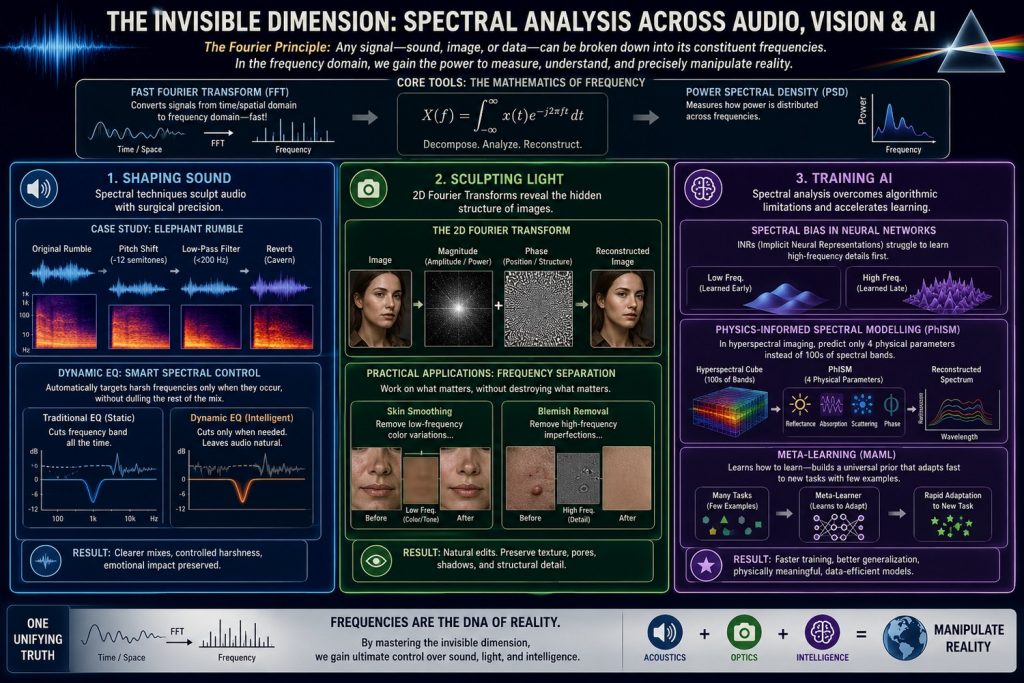
Key Tools: The analysis relies on core mathematical techniques like the Fast Fourier Transform (FFT) to convert data to the frequency domain and Power Spectral Density (PSD) to measure signal power.
1. Shaping Sound:
Spectral techniques are used to sculpt audio with surgical precision. The document details a case study of processing an elephant rumble by shifting pitch, applying low-pass filters, and adding reverb. Dynamic EQ is highlighted as a key advancement, as it automatically targets harsh frequencies (like vocal sibilance) without permanently dulling the rest of the mix.
2. Sculpting Light:
In image processing, 2D Fourier Transforms separate the magnitude (color/power) from the phase (position/structure). This allows for techniques like frequency separation in Photoshop, where skin tones can be smoothed without destroying pores, or blemishes removed without affecting shadows.
3. Training AI:
In AI, spectral analysis helps overcome algorithmic limitations. Implicit Neural Representations (INRs) model continuous signals but suffer from “spectral bias” (difficulty learning fine details). Physics-Informed Spectral Modelling (PhISM) addresses this in hyperspectral imaging by predicting only four physical parameters, while Meta-Learning (MAML) accelerates training by creating universal priors.
Conclusion:
Mastering the “invisible dimension” of frequencies is the ultimate tool for manipulating reality across acoustics, optics, and artificial intelligence.