
A guide to common lens types
This guide covers 15 familiar camera lens types, selected for learning rather than ranked by sales or popularity. The image may be downloaded here.
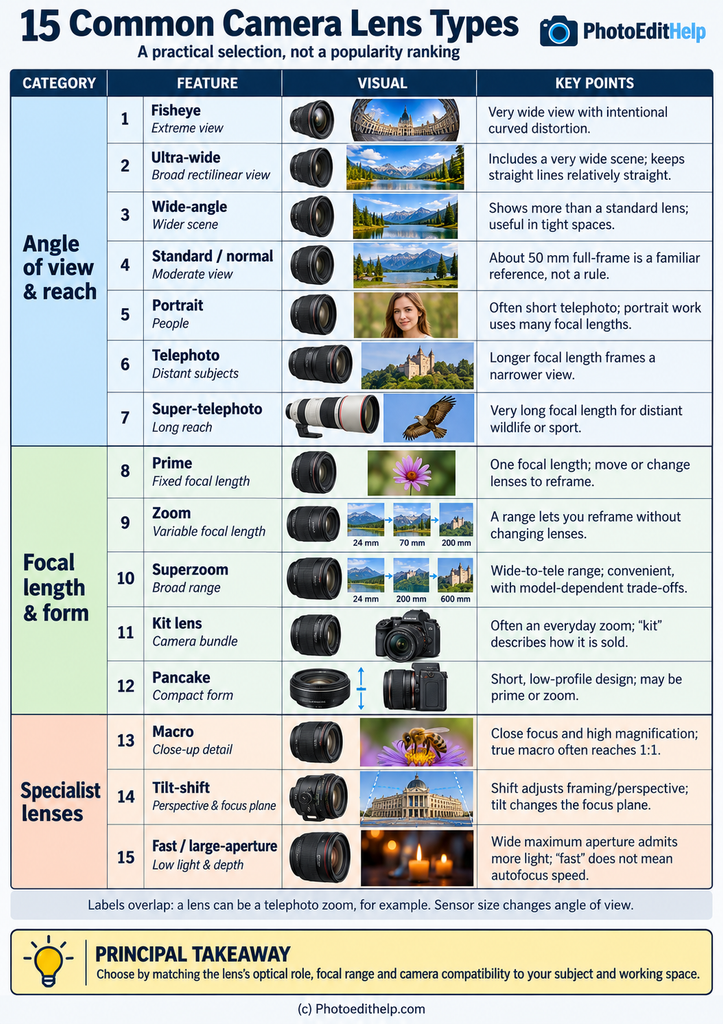
Lens labels describe different things: some indicate angle of view, others focal-length range, physical form or a specialist use. They therefore overlap. A lens can be both a prime and a wide-angle lens, or a telephoto zoom. The category column groups the main idea behind each label, not exclusive classes. Focal length is marked in millimetres; sensor size changes the angle of view, not the lens’s stated focal length.
Field of view and reach
Fisheye lenses capture an extremely wide view with intentional curved distortion. Rectilinear ultra-wide lenses include a very broad scene while keeping straight lines relatively straight; wide-angle lenses show more than a standard lens and suit landscapes or tight interiors. A standard, or normal, lens gives a moderate view; around 50 mm is a familiar full-frame reference, not a universal rule. Portrait lenses are often short telephotos, though portrait work can use many focal lengths. Telephoto lenses frame distant subjects tightly; super-telephotos extend that reach for wildlife and sport. Focal-length boundaries vary, and sensor size changes the angle of view.
Focal length and form
Prime lenses have one fixed focal length; zoom lenses vary focal length within a range. A superzoom spans a particularly broad range, useful when changing lenses is inconvenient, with design trade-offs that vary by model. A kit lens is supplied with a camera, commonly as an everyday zoom; “kit” describes how it is sold, not a specific optical design. Pancake lenses are unusually compact and low-profile, and may be prime or zoom. These labels can describe the same lens from different angles.
Specialist lenses and choosing
Macro lenses focus close and provide high magnification; many true macros reach life-size, or 1:1, reproduction, but check the model’s specification. Tilt-shift lenses move or tilt optical elements to adjust framing or the plane of focus, often for architecture or product work. A fast lens has a wide maximum aperture, letting in more light and allowing shallower depth of field; “fast” refers to aperture, not autofocus speed. For any type, check camera-mount compatibility, sensor format, focal length, focusing distance, aperture and weight. Some lenses are designed for a particular sensor size and may not cover a larger sensor. Choose for your subject, working space and budget. Whatever your goal, read over the chart.
PRINCIPAL TAKEAWAY
Choose by matching the lens’s optical role, focal range and camera compatibility to your subject and working space.
(c) Photoedithelp.com