
Summary
For non-professional users, Large Language Model – AI (LLM -AI)-backed and multimodal graphics tools are already transitioning into the default application for everyday image editing, with near-complete saturation expected by 2028.
While traditional applications required manual navigation of menus, sliders, and layers, casual creators are heavily migrating toward conversational, intent-driven platforms (such as consumer web/mobile suites, CapCut, and chatbot-driven image interfaces).
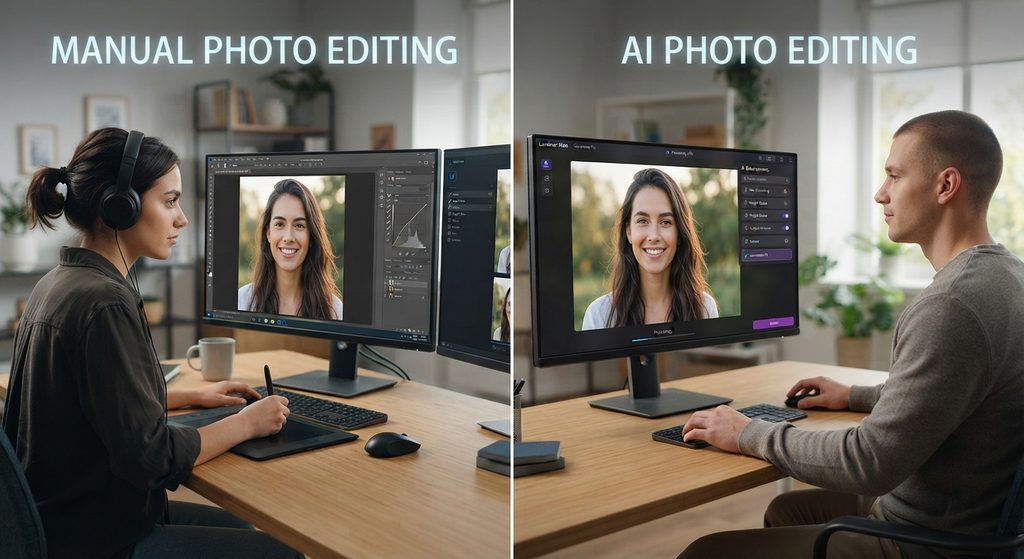
By the end of the decade, the concept of opening a dedicated desktop application to manually crop, brush, or mask a photo for personal or social media use will likely be viewed as an outdated workflow. Traditional editing suites will remain anchored in enterprise and professional markets, but non-professional image editing will be entirely agentic and conversational.
The transition timeline and core drivers can be broken down as follows:
1. Adoption Timeline
- The Current State (2026): Casual users routinely rely on AI-first, prompt-based tools for foundational tasks like background removal, object cleanup, face enhancement, and smart restyling. For over 80% of routine, non-professional image modifications, AI intent engines perform the work faster than traditional manual editors.
- The Tipping Point (2027–2028): Natural language orchestration and conversational multi-turn editing (e.g., modifying specific parts of an image by typing “make the jacket blue and remove the person in the background”) will completely eclipse manual slider-tweaking for mainstream consumers. At this stage, traditional desktop interfaces will feel unnecessarily complex to non-professionals.
2. Why Non-Professionals are Shifting So Fast
- Elimination of the Skill Barrier: Users no longer need to learn technical UI manipulation, masking paths, or color theory; intent is translated directly into pixels via natural language.
- Frictionless Formats: Mobile-first and web-based AI tools eliminate the need for high-end local hardware and heavy installation files, offering instant results.
- Cost and Convenience: Free or low-cost consumer subscription models provide access to advanced generation and retouching without the steep learning curves or rigid subscription fees associated with industrial software suites.
3. High-Volume, Usage-Aligned AI Platforms
For event and wedding photographers handling thousands of RAW files, fixed subscriptions or per-credit limits have boosted specialized volume engines:
| Platform | Pricing Model | AI Execution & Integration | Key Value Proposition |
| Imagen AI | Pay-As-You-Go ($0.05/photo + $7/mo min) or “Limitless” ($129/mo) | Cloud processing; syncs parametric sliders directly back to Lightroom | Learns personal style from past RAW catalogs; processes 1,000 photos in under 10 minutes. |
| Aftershoot | Flat subscription ($20–$60/mo) with no per-image fees | 100% local GPU execution; works fully offline | All-in-one culling, style-based editing, and portrait retouching. |
| Neurapix | Pay-per-picture ($0.04/photo) or Unlimited Flat Rate ($49.95/mo) | Hybrid local/cloud; operates directly via native Lightroom plugin | Low barrier to entry (trains SmartPresets with as few as 20 sample images). |
4. Enterprise Moats & Neural Processing
Traditional desktop software faces the threat of “shell commoditization” if external AI tools handle all heavy lifting, but Photoshop retains a strong industrial competitive advantage :
- Enterprise Safety & Indemnification: Adobe Firefly is trained on licensed content, providing the legal IP protection required by commercial agencies.
- Ecosystem Interoperability: Deep non-destructive links across Adobe Creative Cloud make switching workflows costly for studios.
- Sensor-Level Reconstruction: Tools like DxO DeepPRIME perform advanced local demosaicing that traditional spatial filters struggle to match.
5. Consumer Direction: Conversational & Agentic Intent
For casual creators, manual UI manipulation is being replaced by prompt-driven orchestration:
- Multimodal Generation: Models like OpenAI’s ChatGPT Images allow users to maintain subject consistency and edit via chat.
- Prompt-Driven Workflows: Platforms like CapCut enable multi-platform media asset creation through natural language prompts rather than complex menus.
6. Photoshop’s Evolving Hybrid Strategy
To stay competitive against specialized point solutions, Photoshop is shifting toward becoming an open agentic host that combines:
- Conversational Intent Layers: Utilizing open protocols (like Model Context Protocol) to let natural language prompts adjust sliders or generate masks.
- Parametric & Manual Precision: Retaining non-destructive manual controls and pixel-level precision so professionals can fine-tune autonomous AI outputs.
Consider looking at these videos –
Glyn Dewis (ChatGPT in Lightroom) , Braydon Carter (ChatGPT) , Tech Life Unity (Gemini)