
SCOTTISH WILDLIFE: BIODIVERSITY, HABITATS & OBSERVATION ETHICS
A Field Guide to Native Species, Classification, and Responsible Fieldcraft
Scotland’s diverse landscapes – ranging from the maritime Atlantic seaboard to sub-arctic montane plateaus and remnant Caledonian pinewoods – host some of Britain’s most iconic and vulnerable wildlife.
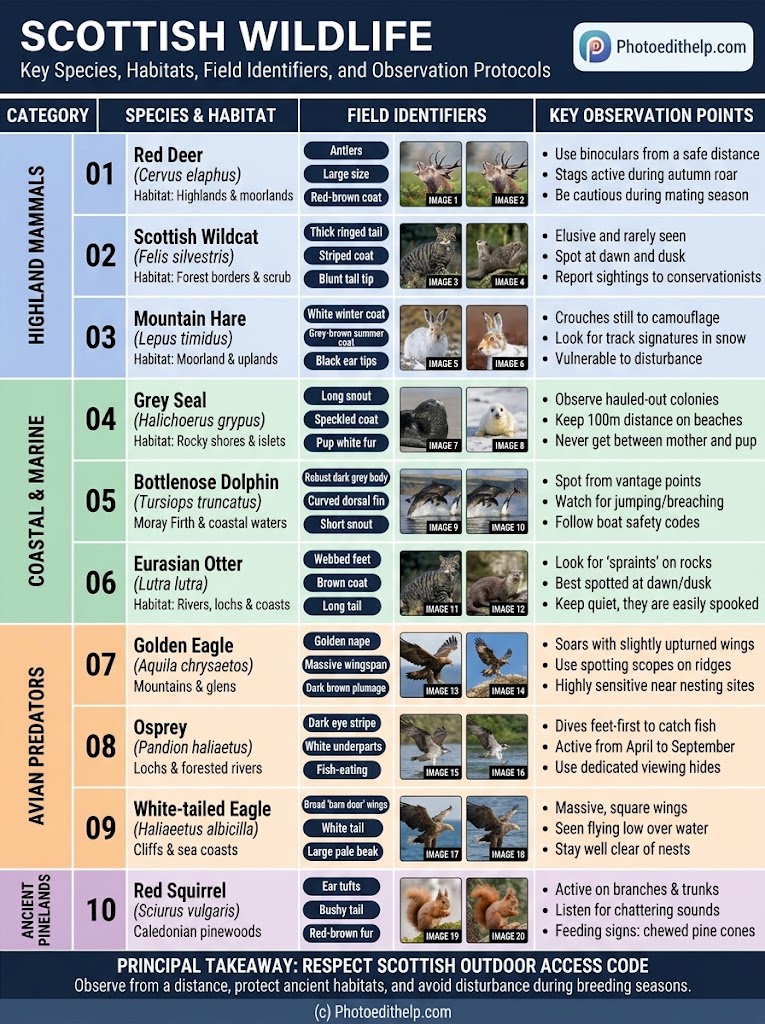
This Informatic may be downloaded here in JPG format
Effective wildlife identification and ethical observation require understanding how species occupy distinct ecological niches. Encounters depend on recognizing territorial boundaries, seasonal coat changes, and behavioural cues. A structured, low-impact fieldcraft approach ensures that field naturalists, photographers, and visitors observe these creatures in their authentic environments without inducing physiological stress or displacing them from crucial feeding and breeding territories.
Observing upland and montane mammals demands an appreciation of seasonal adaptations and keen awareness of terrain. The red deer, the UK’s largest terrestrial mammal, shapes Highland glens and displays dramatic behavioral shifts during the autumn rut, where dominant stags hold territories through vocal roars and physical clashes. In higher alpine zones, the mountain hare demonstrates remarkable climate adaptation, shedding its summer brown pelage for a winter-white coat to camouflage against snowfields. Concurrently, the critically endangered Scottish wildcat – distinguished by its blunt, black-banded tail and un-tapered silhouette – inhabits forest margins and moorland edges, requiring silent, non-intrusive observation techniques and telephoto optics to observe without causing disturbance.
Along Scotland’s coastal fringes, sea lochs, and turbulent firths, marine mammals demonstrate rich predator-prey dynamics. Grey seals haul out on remote rocky skerries, particularly during autumn pupping windows when mothers fiercely protect vulnerable white-coated pups. Further out in open waters, the resident Moray Firth population of bottlenose dolphins navigates tidal channels, often surfacing close to headlands on incoming tides. In both freshwater burns and coastal shallows, the Eurasian otter thrives as an elusive, solitary hunter. Recognizing signs such as spraint on prominent rocks and distinctive surface bubble trails allows naturalists to locate otters while maintaining a safe downwind vantage point.
In the skies and ancient pinewoods, Scotland’s raptors and arboreal specialists anchor complex ecosystems. The golden eagle rules vast open mountain ranges with characteristic high-altitude thermal soaring, while the white-tailed eagle—reintroduced along rugged sea cliffs—dominates marine shorelines with its immense, broad-winged silhouette. During the summer breeding months, migratory ospreys nest on mature Scots pine crowns, hunting shallow freshwater lochs with precise plunging dives. Below the canopy, the native red squirrel depends on ancient pine cones and conifer seeds, relying on continuous forest canopies for safe transit. Upholding ethical observation guidelines ensures these fragile habitats and populations remain resilient across the Highlands.
PRINCIPAL TAKEAWAY: RESPECT SCOTTISH OUTDOOR ACCESS CODE
Observe from a distance, protect ancient habitats, and avoid disturbance during breeding seasons.
(c) Photoedithelp.com