
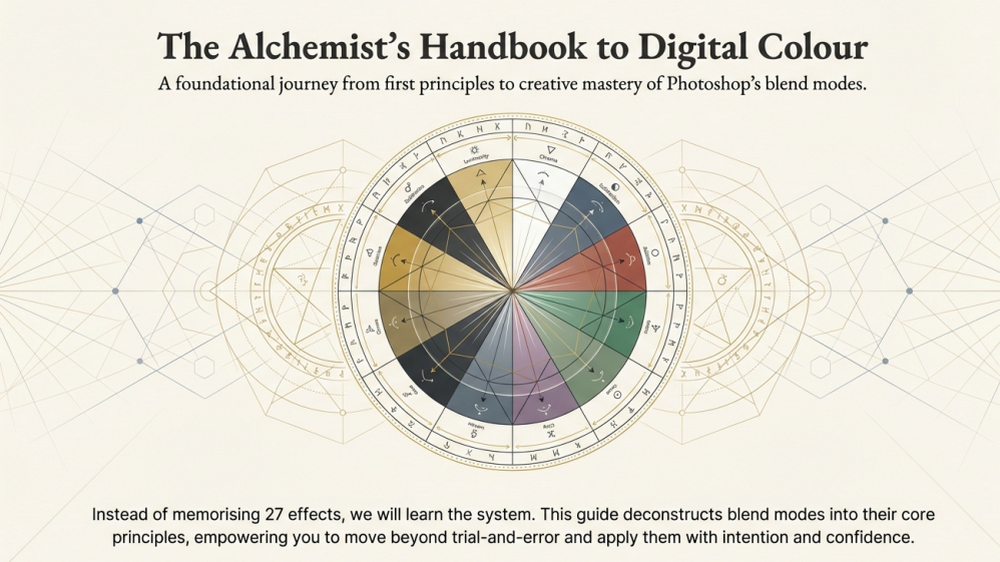
Tired of randomly cycling through blend modes, hoping for a happy accident? It’s time to stop guessing. These principles are the keys to unlocking the system, turning random chance into masterful intent. Download the Handbook here.
The 5 Takeaways
1. Stop Memorizing, Start Understanding !
The key isn’t knowing every effect. It’s about learning the core principles that govern how they all work. This shift empowers you to apply modes with confidence and solve visual problems with purpose. Instead of memorising 27 effects, learn the system.
2. Every Blend is a Simple Equation
Each blend mode is a mathematical calculation where a pixel from the Base layer combines with a pixel from the Blend layer to create a final Result. This demystifies the process, turning unpredictable “magic” into a predictable algorithm.
3. Contrast Modes Are Just Clever Hybrids !
The entire Contrast family operates on a single, elegant piece of logic. They are not new, complex modes, but clever combinations of what you already know, designed to create visual drama.
“The contrast modes are hybrids. They ask a simple question of the pixels: ‘Is this colour lighter or darker than 50% grey?’ Based on the answer, they apply a lightening mode (like Screen) or a darkening mode (like Multiply).”
4. Fill vs. Opacity Is a Game-Changer
This is the Alchemist’s secret. For eight “Special” modes (like Color Burn), reducing Opacity makes the final result translucent. But reducing Fill scales the intensity of the blend effect itself, unlocking dramatically richer and more nuanced results.
The 8 special blend modes that treat “Fill” and “Opacity” differently, offering unique results when adjusting their values, are Color Burn, Linear Burn, Color Dodge, Linear Dodge (Add), Vivid Light, Linear Light, Hard Mix, and Difference, noted for their distinct behavior compared to other modes where Fill and Opacity adjustments yield identical outcomes.
5. “Blend If” Isn’t a Blend Mode—It’s Your Secret Weapon
“Blend If” is a powerful rule set. Think of it as “Make see-through if…”. It makes a layer’s effect transparent based on luminosity, creating precise tonal masks that, unlike static masks, dynamically re-evaluate the image.
Conclusion
The Alchemist’s goal is not random tests, but true transformation. You now hold the principles to move beyond experimentation and begin your journey to mastery.
What will you create with intention?