
Zoom Lens: How It Works
1. Overall Summary
A photographic zoom lens combines precision optical elements, mechanical assemblies and electronic systems to provide variable focal lengths, accurate focusing and controlled light transmission. Internal lens groups move to adjust magnification, while aperture, autofocus and image stabilisation systems help produce sharp, correctly exposed photographs.
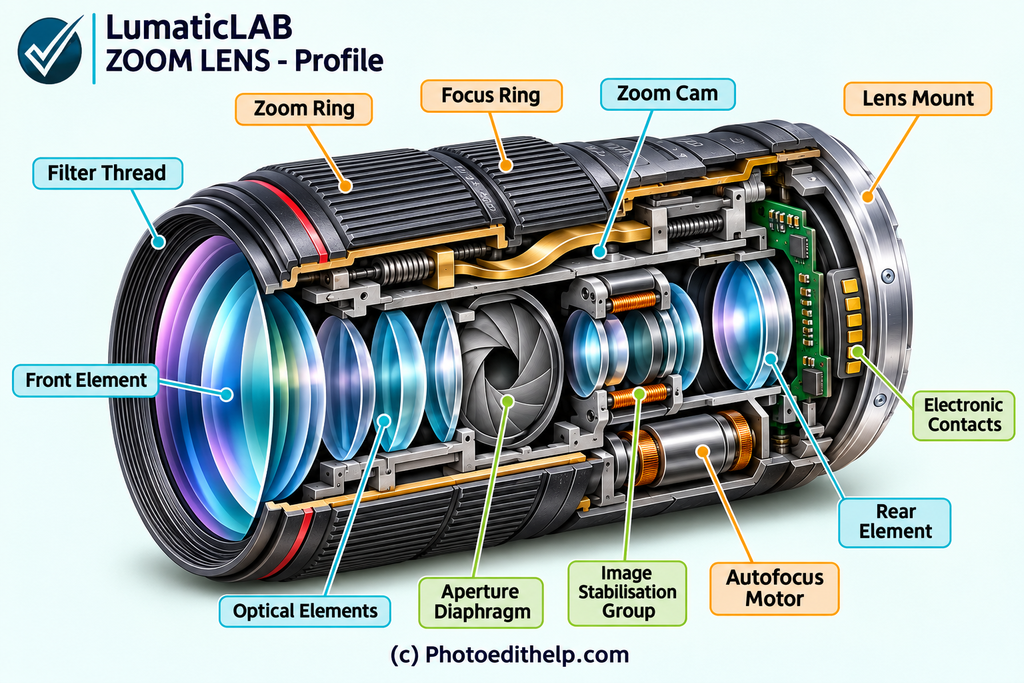
2. Individual Component Breakdown
External Controls and Structure
1. Zoom Ring
Rotates to change the lens focal length, moving internal optical groups to adjust magnification and the angle of view.
2. Focus Ring
Allows manual adjustment of focus, controlling the position of focusing elements to bring the selected subject into sharp definition.
3. Filter Thread
A threaded fitting at the front of the lens that accepts compatible photographic filters, protective filters and other optical accessories.
4. Lens Mount
The mechanical and electrical connection between the lens and camera body, providing secure attachment and communication between their systems.
Optical Assembly
5. Front Element
The foremost optical element receives incoming light and forms part of the optical system that directs light through the lens.
6. Optical Elements
Precision-shaped glass elements arranged in groups to focus light, correct optical aberrations and maintain image quality throughout the zoom range.
7. Rear Element
The rearmost optical element helps direct light towards the camera sensor, contributing to the overall optical performance of the lens.
8. Aperture Diaphragm
An adjustable arrangement of overlapping blades that controls the amount of light passing through the lens and influences depth of field.
Mechanical and Electronic Systems
9. Zoom Cam
A mechanical cam mechanism that translates rotation of the zoom ring into controlled movement of internal optical groups to change focal length.
10. Image Stabilisation Group
A movable optical group that compensates for camera movement, helping reduce image blur caused by hand movement during exposure.
11. Autofocus Motor
An electrically powered mechanism that moves the focusing elements automatically in response to focusing commands from the camera body.
12. Electronic Contacts
Electrical connections that allow the lens and camera body to exchange information about autofocus, aperture, focal length and other lens functions.
3. Educational Notes and Caveats
The illustration represents a typical modern electronically controlled photographic zoom lens. It is an educational cutaway rather than an engineering drawing of a particular manufacturer’s model.
- Optical construction: The number, shape, materials and positioning of optical elements vary considerably between manufacturers, focal lengths and lens designs.
- Zoom mechanisms: Internal optical groups may move using cam tracks, helicoids or other mechanical arrangements. Not every zoom lens uses the same mechanism.
- Image stabilisation: Optical stabilisation is not universal. Some lenses have no stabilisation, while some cameras provide stabilisation through the camera body.
- Autofocus motors: Different technologies include stepping motors, ultrasonic motors and other electromagnetic drive systems. Their speed, noise and operating characteristics vary.
- Aperture control: Modern lenses commonly use electronically controlled diaphragms, although older designs may use mechanical linkages.
- Focus and zoom controls: Some lenses use conventional mechanical rings, while others employ electronic focus-by-wire controls.
- Lens mounts: Mount designs, electronic contacts and communication protocols differ between camera manufacturers and systems.
- Filter threads: Not every lens has a conventional front filter thread. Some specialist lenses use rear-mounted filters or alternative filter holders.
- Lens materials: Optical elements may use different types of optical glass, specialised coatings and, in some designs, other optical materials.
- Internal layout: The diagram simplifies the internal construction to make the principal components easier to understand. Actual lens assemblies can be considerably more complex.
Important Educational Distinction
A zoom lens does not simply move one glass element backwards and forwards. It uses coordinated movement of optical groups to change focal length while maintaining acceptable focus and image quality.