
LUMATIC LAB: Convert ACV to LUT (FREE) – Upgrade
The application is aimed at photographers, editors and small creative teams who need a reliable way to move acv file tonal adjustments between platforms without variation.
Read more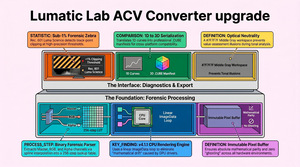
The application is aimed at photographers, editors and small creative teams who need a reliable way to move acv file tonal adjustments between platforms without variation.
Read more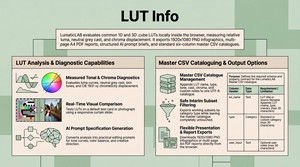
LumaticLAB LUT Analysis examines a common cube LUT locally in the browser. It can create a 1920 by 1080 infographic, a four-page A4 report, an enlarged diagnostic viewer, a structured AI prompt and a sort-able master CSV catalogue dependant on the User.
Read more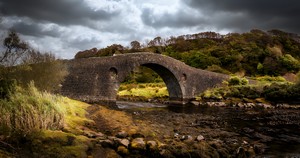
Foreground geometry and detail remain intact. • No obvious halos or cut-out edges around trees, branches or the bridge. • The replacement sky sits naturally in the scene. • Foreground light and colour respond plausibly to the new sky. • The result reads as one continuous photograph.
Read more
ConservationLAB was created as short or vague prompts forces generative AI models to fill in missing context using statistical averages and training defaults, which frequently produces generic clichés, unpredictable compositions, or visual and factual errors.
Read more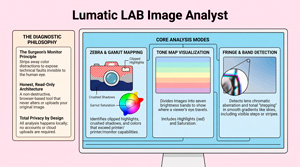
The UPDATED Interactive Image Analyst is a FREE browser-based diagnostic tool designed by LumaticLAB to help photographers identify technical flaws without altering the original file..
Read more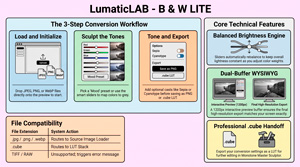
B & W Lite is a streamlined, offline image processing FOUNDATION tool designed to help beginners understand how to convert photographs into monochrome masterpieces using a precise, unified transformation engine.
Read more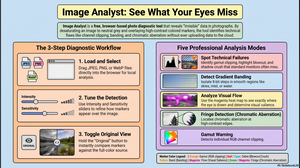
Every photograph hides information your eye glosses over. A sky that looks smooth is quietly banding into steps. A highlight you thought was bright is actually clipped, its detail gone for good. A corner of the frame is pulling attention away from your subject without you noticing. Image Analyst is[…]
Read more
Professional Digital Asset Management (DAM) software addresses the challenge. of large numbers of images. Excire Photo 2027 is designed specifically for managing very large photo libraries spread across multiple drives.
Read more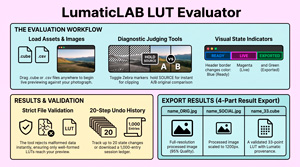
The friction of “blind” LUT application ends here. The LUT / CSV Evaluator provides the instant, offline environment needed to verify looks before they reach your workflow.
Read more
The primary purpose of the LUMATIC LAB Resampler is to enable a User to standardise the 3D LUTs they use by converting various cube sizes (such as 17³, 64³, and 65³) into a universally compatible format,
Read more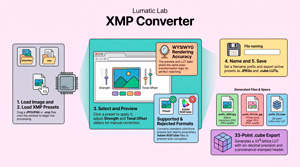
The XMP Converter, is a browser-based utility designed to transform Adobe Lightroom and Camera Raw presets into more portable 33-point .cube LUTs ensuring your creative vision remains consistent across diverse production environments. XMP files serve as the underlying “recipe” for Lightroom Presets, enabling non-destructive editing by storing adjustments as text metadata. When you edit a photo, you are merely[…]
Read more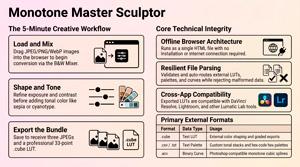
The Monotone Master Sculptor has a 4-stage workflow that can be summarised as Load, Build, Sculpt, and Export. Here is how you use each stage to edit your photos: Stage 1: Load (Input) Stage 2: Build the Foundation Stage 3: Sculpt theTones This stage involves manipulating light, contrast, and chemical[…]
Read more
We’ve made a small update to this little tool. It is similar to Adobe’s Photoshop Color Picker and has saved us quite a lot of time when creating and the website and documenting our apps. Creative professionals often grapple with the subjectivity of color—the “which blue?” ambiguity. This friction compromises[…]
Read more
Lumatic LAB – Mono Sculptor – Is For You There is also a Technical Reference Guide that provides an in-depth reference covering the signal processing pipeline, mathematical operations, file formats, architectural constraints, and advanced usage guidance. As this is really quite technical it is not included in the downloads but[…]
Read more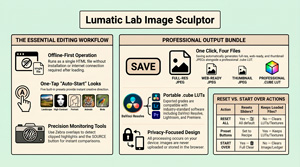
Lumatic Lab – Image Sculptor – whilst not being aimed at professional photo-editors and colourists, the app has many of the features Users need to complete their work. The app is continually being updated and more features will be added as further functionality is made available to web browsers
Read more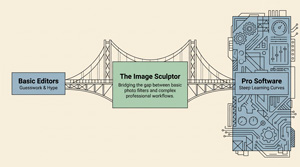
Image Sculptor – Professional Portability Without the Price Tag. Image Sculptor by Lumatic Lab is a free, privacy-focused web application designed for photography enthusiasts who require more creative control than basic editors offer without the complexity of professional software. It also helps in today’s economically challenged world by being optimized[…]
Read more
One of the stays on the Bridge of Oich. The bridge is a taper principle suspension bridge, designed by James Dredge, across the River Oich near Aberchalder in Highland, Scotland. The bridge was opened in 1854, after floods swept through the Great Glen and destroyed the old stone bridge over[…]
Read more
Delivering clean, striking black & white photos without complicated software, B & W Master Sculptor gives you a simple, fast way to get there – no installs, no accounts, and absolutely FREE. Your images stay yours — always This is the core principle behind everything here: What it actually does[…]
Read more
Today we are posting an update to the ACO Convertor including a support pack (ZIP) format containing a demo image, ACO file and full documentation. The ACO Convertor is one part of the collection of Lumatic LAB modular software utilities designed to convert diverse design assets into industry-standard 3D LUTs. Have[…]
Read more
Lumatic LAB offers a suite of free, browser-based tools designed to transform various file formats, such as Adobe gradients and presets, into universal Look-Up Tables (LUTs).
Read more
Is a specialized tool designed to convert Adobe Photoshop gradient files (.grd) or specifically formatted .txt and .csv files into standardized .cube LUTs. Protect YOUR preset library; don’t let it die with a canceled subscription. Beyond conversion, the software incorporates a Tonal Analysis Panel with real-time histograms and dynamic exposure controls to ensure visual integrity during the[…]
Read more
The Lumatic Lab Style Matcher is a sophisticated image processing utility designed for tonal and colour distribution transfers. It is a tonal remapper and should not be confused a basic pixel replacement or colour overlays, so often shown as ‘night scope’ colouring, this engine employs histogram matching and cumulative distribution function mapping to align the[…]
Read more
The converter is designed to require no technical knowledge. As with all our Apps it is FREE, runs on modern web browsers and entirely locally so your personal data is not at risk and your images will not be ‘scraped’ or used for AI training purposes.You do not need a login, there is no fee to pay,[…]
Read moreLUTs Should Work Everywhere – Not Just Where They Were Made Creative tools don’t agree on standards – Some LUTs are built at 17³ for speed – Others at 65³ for cinematic precision. But most real-world editing environments quietly expect something in between but 33³ is the practical sweet spot[…]
Read more
The Color Palette Generator is a sophisticated web application built with Next.js to assist photographers and web designers master color theory. It features a professional-grade color picker and harmony panels that automatically calculate diverse schemes, such as monochromatic and triadic relationships. Users can extract palettes directly from uploaded images, fine-tune selections using HSL or HEX inputs, and test designs through color[…]
Read more